Word count: ~2,400 words | Reading time: 10 minutes

You invested in a beautiful website. Your social media posts get likes. Your brand looks professional. But your phone isn’t ringing, your contact form sits empty, and your competitors are somehow getting all the business.
Sound familiar?
You’re not alone. In Austin, College Station, Houston, and across Texas, thousands of business owners face this exact problem every single day. They’ve checked the boxes—website, Instagram, Facebook—and wondered why customers aren’t flooding in. The answer is simpler (and more fixable) than you think. I’ve had this conversation with a lot of business owners and so, so many are missing this.
The brutal truth: Having a website and social media presence is like opening a beautiful storefront in the middle of nowhere with no roads leading to it. People can’t visit if they can’t find you.
The Pretty Website Trap: Why Looking Good Isn’t Enough
Let’s start with a story that plays out every week in Austin.
Maria owns a dental practice in South Austin. Last year, she spent $8,000 on a gorgeous new website. Modern design. Fast loading times. Beautiful photos of her office. Her web designer told her it was “mobile-optimized” and “professional.”
Six months later, Maria’s still getting most of her patients from word-of-mouth referrals. Her website? Getting maybe 20 visitors per month. Most of them are existing patients looking up her phone number.
Meanwhile, her competitor across town—with an uglier website that looks like it was built in 2015—is booked solid three weeks out. Why? Because when someone in Austin searches “dentist near me” or “emergency dental Austin,” her competitor shows up. Maria doesn’t.
The Difference Between a Website and a Working Website
Here’s what most business owners don’t understand: Your website is not a digital brochure. It’s supposed to be a customer acquisition machine.
A pretty website without strategy is like buying a Ferrari and never putting gas in it. Sure, it looks impressive in your driveway, but it’s not taking you anywhere.
In Austin and throughout Texas, we see this pattern constantly:
- Restaurant with stunning photos but doesn’t show up for “best tacos College Station”
- HVAC company with a modern site that’s invisible for “AC repair Houston emergency”
- Law firm with professional headshots that doesn’t rank for “personal injury lawyer Austin TX”
- Realtor with beautiful property galleries who’s nowhere to be found when buyers search “homes for sale near me”
These businesses made the same mistake: they focused on aesthetics and forgot about visibility.
Why Your Web Designer Didn’t Tell You This
Most web designers are exactly that—designers. They understand color theory, user experience, layout, and branding. What they don’t typically understand is search engine optimization, local search algorithms, or how Google’s AI decides which businesses to show to potential customers.
That’s not a criticism. It’s just not their specialty. You wouldn’t expect your graphic designer to also be an accountant, right?
The problem is that business owners assume “building a website” automatically means “building something that brings customers.” It doesn’t. Those are two completely different skill sets.
The Social Media Illusion: Why Likes Don’t Pay Your Bills
Let’s talk about the other half of the equation: social media.
You’re posting consistently on Instagram. Your Facebook page has hundreds of followers. You’re even trying TikTok because everyone says that’s where the attention is. You get likes, comments, maybe even some shares.
But here’s the uncomfortable question: How many of those likes turned into paying customers last month?
The Billboard Metaphor: Understanding Social Media’s Real Role
Think of your social media presence like a billboard on I-35 in Austin. It’s great for brand awareness. People who drive past it regularly might remember your name. Some of them already know about your business and the billboard reminds them you exist.
But here’s what a billboard can’t do: It can’t capture someone at the exact moment they need your service. It can’t appear when someone searches “emergency plumber Austin 2am.” It can’t show up when a potential customer types “best divorce lawyer College Station” into their phone.
Billboards (and social media) are interruption marketing. You’re interrupting someone’s commute or their scroll through vacation photos to show them your ad. They weren’t looking for you. You’re hoping to create awareness for a future need.
That has value. But it’s not the same as being there when someone is actively searching for what you offer.

Social Media Reach Is Dead (And You Know It)
Let’s be honest about something else: organic social media reach has been declining for years. Facebook shows your posts to maybe 2-5% of your followers unless you pay to boost them. Instagram’s algorithm decides who sees your content, and it’s not showing your posts to potential customers—it’s showing them to people who already engage with you.
Translation: Social media is increasingly just showing your content to people who already know you exist. That’s nice for staying top-of-mind, but it’s not bringing new customers through your door.
For Austin, Houston, and College Station businesses competing in crowded markets, that’s a major problem. You’re not expanding your customer base. You’re just talking to the same circle of existing customers and their friends.
How People Actually Find Businesses in Austin (And Why You’re Missing Them)
Let me walk you through what happens when someone needs a service in Austin, College Station, or Houston.
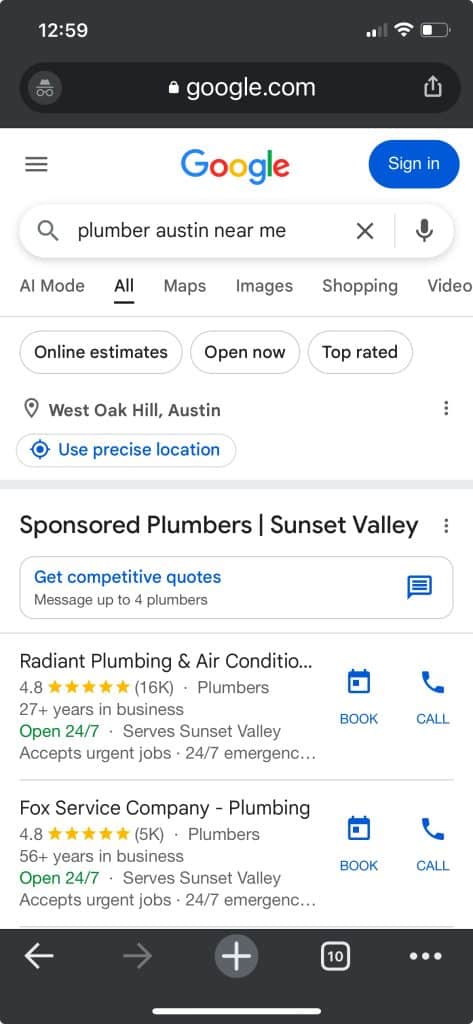
It’s 11 PM on a Tuesday. A pipe bursts in someone’s home in South Austin. What do they do?
They don’t scroll Instagram hoping to see a plumber’s post. They don’t check Facebook to see if any plumbing companies have posted recently. They definitely don’t wait until morning to ask friends for recommendations.
They pull out their phone and search: “emergency plumber Austin” or “24 hour plumber near me”
Google shows them three plumbers in the local map pack at the top of the results. Below that, ten more organic results. The person calls one of the first three they see.
If your business isn’t in those top results, you don’t exist. It doesn’t matter how beautiful your website is. It doesn’t matter that you posted on Instagram yesterday. You missed the customer at the exact moment they were ready to hire someone and pay money.
The 93% Problem: Why Google Search Dominates Customer Acquisition
Here are the numbers that should terrify and motivate you:
- 93% of online experiences begin with a search engine (most of them Google)
- 46% of all Google searches have local intent—people looking for businesses near them
- 76% of people who search for something nearby visit a business within 24 hours
- 28% of local searches result in a purchase within one day
Think about what that means for your Austin-area business. Nearly half of all searches on Google are people looking for local businesses. Three-quarters of them will visit a business the same day. But if you’re not showing up in those searches, you’re invisible to them.
This isn’t theory. This is happening right now while you’re reading this article. Potential customers in Austin, College Station, and Houston are searching for businesses exactly like yours. They’re ready to spend money. And they’re hiring your competitors because your competitors show up and you don’t.
AI Search Is Making This Worse (Or Better, If You Know What You’re Doing)
Here’s the new wrinkle: AI-powered search is changing how people find businesses.
ChatGPT, Google’s AI Overviews, Bing Chat, and other AI tools are increasingly answering questions with direct recommendations. When someone asks “Who’s the best HVAC company in College Station?”, AI tools scan the web and provide specific recommendations.
Guess which businesses they recommend? The ones with strong online presence, lots of reviews, clear information about their services, and—you guessed it—proper SEO.
If your website doesn’t have the right signals, AI search tools will never mention your business. You won’t just be invisible to Google. You’ll be invisible to the next generation of search entirely.
Understanding SEO: The Roads That Lead to Your Business
Okay, so if a beautiful website is just a storefront and social media is just a billboard, what actually brings customers to your business?
Search Engine Optimization (SEO). Specifically, local SEO.
Here’s the metaphor that makes this clear: SEO builds the roads, highways, and signs that lead customers directly to your storefront when they’re actively looking for what you offer.
Without SEO, you’re sitting in that beautiful storefront waiting for people to stumble upon you by accident. With proper SEO, you’re positioned right on the main highway where everyone who needs your service drives past—and they see clear signs pointing directly to your door.
What SEO Actually Means (In Plain English)
SEO is the practice of making your website visible and attractive to search engines like Google so that when someone searches for services you offer, your business shows up in the results.
But here’s where it gets complex: Google uses over 200 different factors to decide which websites to show for any given search. These factors include:
- The words and phrases on your website (keywords)
- How other websites link to you (backlinks)
- Your Google Business Profile optimization
- Your website’s technical structure and speed
- The relevance of your content to search queries
- Your online reviews and ratings
- How far away you are from the person searching
- How mobile-friendly your site is
- How long people stay on your site once they visit
- And about 190 other factors…
All of these factors interact with each other. Google’s algorithm is constantly being updated. What worked six months ago might not work today.
Local SEO: The Secret Weapon for Austin-Area Businesses
For businesses serving Austin, College Station, Houston, and the surrounding Texas areas, local SEO is everything.
Local SEO focuses specifically on making your business visible when people search for services “near me” or in specific cities. It involves:
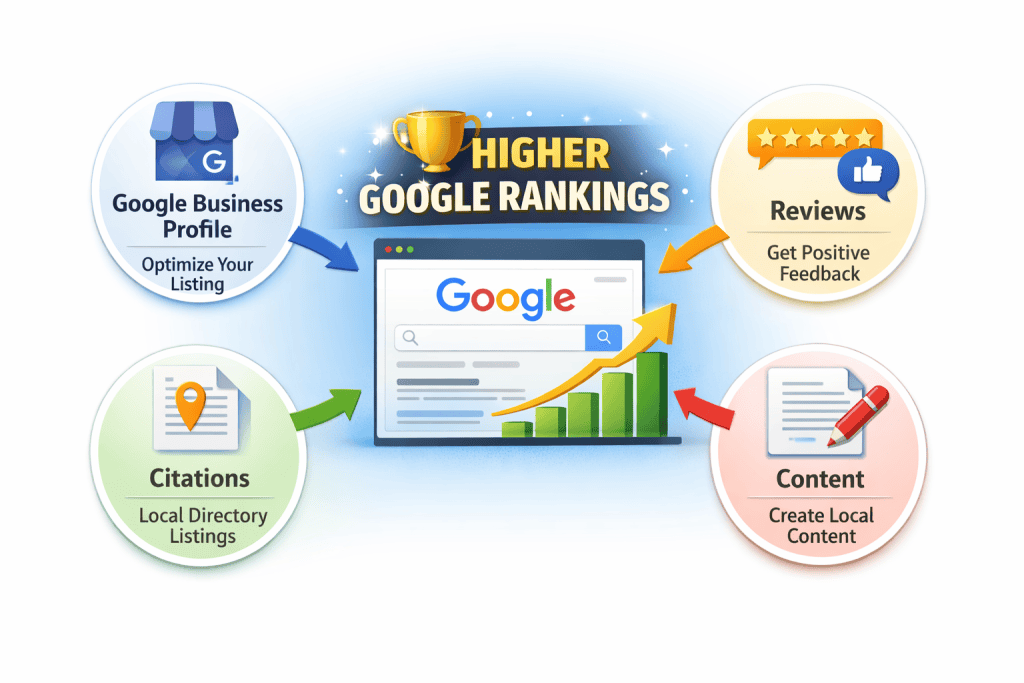
Google Business Profile optimization: Your Google Business Profile (formerly Google My Business) is the single most important factor in local search. When someone searches “restaurants near me” in Austin, Google shows them a map with three businesses. That’s the “local pack,” and getting into it requires a fully optimized, consistently updated Google Business Profile with lots of positive reviews.
Location-specific content: Your website needs to clearly signal to Google which areas you serve. That means having pages and content that specifically mention Austin, College Station, Houston, or whatever cities you target. Just saying “Texas” isn’t specific enough.
Local citations: Your business name, address, and phone number need to appear consistently across hundreds of online directories—Yelp, Yellow Pages, industry-specific directories, local chamber of commerce sites, etc. Every inconsistency confuses Google and hurts your rankings.
Reviews management: Google heavily weighs customer reviews when deciding which businesses to show. More reviews, more recent reviews, and higher ratings all boost your visibility. But getting and managing reviews requires a systematic approach most businesses don’t have.
Mobile optimization: Most local searches happen on mobile devices. If your site doesn’t load quickly and look good on phones, Google won’t show it to mobile searchers—which is most of your potential customers.
Getting all of this right requires specialized knowledge, consistent effort, and constant monitoring. It’s not something you can “set and forget.” Google’s algorithm changes constantly. Your competitors are trying to outrank you. New businesses enter your market.
Why DIY SEO Usually Fails (And Wastes Your Time)
At this point, you might be thinking: “Okay, I get it. I need SEO. I’ll figure it out myself.”
Before you go down that path, let me tell you what usually happens when business owners try to DIY their SEO:
Month 1: You start reading blogs and watching YouTube videos about SEO. You feel overwhelmed by the technical jargon but optimistic that you can learn this.
Month 2: You make some changes to your website based on what you learned. You update some page titles, add some keywords, maybe create a Google Business Profile. You check your rankings obsessively. Nothing changes.
Month 3: You realize SEO is more complex than you thought. You learn about backlinks, domain authority, technical SEO audits, schema markup, and dozens of other concepts. You try to implement a few things. Some of them work, most don’t. You’re spending 10-15 hours per week on this.
Month 4: You get frustrated. Your rankings improved slightly for one keyword but tanked for another. You’re not sure why. You’re spending more time on SEO than running your actual business. The ROI isn’t clear.
Month 5-6: You give up or let it slide. You’ve invested dozens of hours and have little to show for it. Your website still doesn’t bring in customers.
The Opportunity Cost of DIY SEO
Here’s the math that business owners in Austin don’t often consider:
Let’s say you’re a contractor who bills $150 per hour for your work. You spend 10 hours per week trying to learn and implement SEO. That’s 40 hours per month. At your billing rate, that’s $6,000 per month in opportunity cost—the money you could have earned doing what you’re actually good at.
Even if you hire a professional SEO service for $700-$1,500 per month, you’re saving thousands of dollars in opportunity cost. Plus, the professionals will actually get results because they know what they’re doing.
And there’s another factor: mistakes in SEO can hurt you. Some outdated tactics can actually get your site penalized by Google, making you even less visible than before. Professionals know which tactics work today and which ones will get you in trouble.
The Real Solution: Combining Local SEO with Strategic Content
Here’s what actually works for Austin, College Station, and Houston businesses that want to be found online:
You need a comprehensive approach that combines local SEO fundamentals with strategic content creation. That means:
1. Optimized Google Business Profile that’s constantly updated, managed for reviews, and filled with relevant photos and posts
2. Location-specific website content that clearly signals to Google which areas you serve and what services you offer
3. Consistent citation building and management across all the directories that matter for your industry
4. Strategic video content that showcases your expertise, builds trust, and gives search engines more content to rank (video is increasingly important in search results)
5. Regular content updates that signal to Google your site is active, relevant, and authoritative in your field
6. Technical optimization that makes your site fast, mobile-friendly, and easy for search engines to crawl
This isn’t a one-time project. It’s an ongoing process. But done correctly, it transforms your website from a pretty digital brochure into a customer acquisition machine that works 24/7.
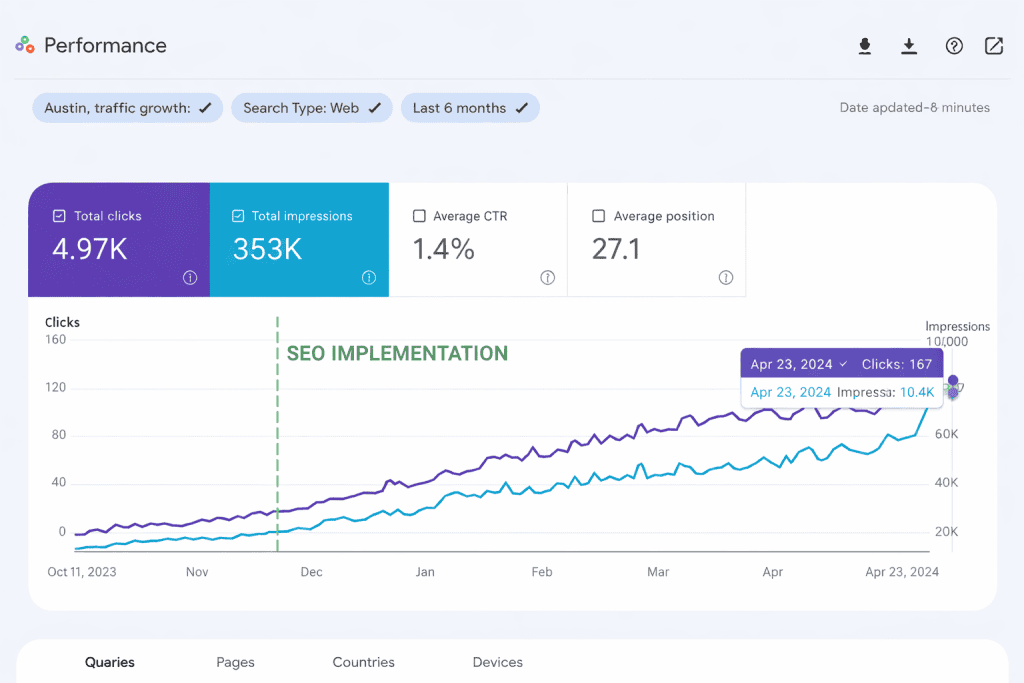
Why Video + SEO Is the Winning Combination
Here’s something most Austin businesses don’t realize: video content significantly boosts your SEO.
When you have video on your website:
- People stay on your site longer, which signals to Google that your content is valuable
- You can rank in both regular search results AND video search results, doubling your visibility
- Video shows up in Google’s AI-powered search features more often than text-only content
- People are more likely to trust and remember your business after watching a video
- You can use video on social media to drive traffic back to your optimized website
The businesses that are winning in local search aren’t choosing between video marketing and SEO. They’re doing both, and they’re seeing compound returns because the two strategies amplify each other.
What Austin Business Owners Need to Do Today
If you’ve made it this far, you understand the problem. Your beautiful website and active social media aren’t enough because they’re not bringing you customers at the moment those customers are searching for your services.
So what do you do about it?
Step 1: Audit Your Current Visibility
First, figure out where you actually stand. Search for your services in Austin (or College Station, or Houston—wherever you operate) and see if you show up. Try these searches:
- “[your service] near me” (while in your target city)
- “[your service] + [your city]”
- “best [your service] [your city]”
- “[your service] [your neighborhood]”
Are you on page one? In the map pack? Nowhere to be found?
That tells you how much work needs to be done.
Step 2: Decide If You’re DIY or Hiring Help
Be honest with yourself: Do you have the time, knowledge, and consistency to do this right? Or would your time be better spent serving customers while someone else handles your marketing?
For most business owners in competitive Austin markets, the answer is clear. Your time is worth more than $700-$1,500 per month. Hiring professionals who know local SEO and video marketing isn’t an expense—it’s an investment that pays for itself many times over.
At Elevated Media Lab, we’ve built our entire business model around making professional SEO + video marketing affordable for local Texas businesses. We know most of you can’t afford the $3,000-$5,000 per month that big agencies charge. That’s why our pricing starts at $575 per month—because we believe every Austin, College Station, and Houston business deserves to be found online.
Step 3: Create a 90-Day Action Plan
Whether you DIY or hire help, you need a plan. Here’s what the first 90 days should look like:
Days 1-30:
- Claim and optimize your Google Business Profile
- Audit your website for basic SEO issues
- Get your business listed in major directories with consistent information
- Start asking satisfied customers for Google reviews
Days 31-60:
- Create or optimize location-specific pages on your website
- Produce 2-3 videos showcasing your services
- Build citations in 20-30 relevant directories
- Monitor your rankings and adjust strategy based on results
Days 61-90:
- Continue building content and citations
- Start seeing initial ranking improvements
- Track which keywords are driving actual customer inquiries
- Double down on what’s working
By day 90, you should be seeing measurable improvements in your visibility and actual customer inquiries from your website.
The Bottom Line: Visibility Equals Viability
Your Austin business deserves to be found. You offer quality services. You care about your customers. You’ve invested in looking professional online.
But if potential customers can’t find you when they’re actively searching for what you offer, none of that matters. You’re losing business to competitors who might not be better than you—they’re just more visible.
The good news? This is fixable. Local SEO isn’t magic. It’s a systematic process that works when done correctly. Combined with strategic video content that builds trust and engagement, it transforms your online presence from “pretty but invisible” to “actively bringing customers through your door.”
The question isn’t whether you need to fix this. You do. The question is: how much longer are you willing to leave money on the table?
Every day you’re not showing up in local search results is another day your competitors are getting customers who should have been yours. Every search for “[your service] Austin” that doesn’t show your business is a missed opportunity.
Want to see exactly where your business stands and get a specific action plan? Contact Elevated Media Lab for a free visibility audit. We’ll show you exactly where you’re showing up (or not showing up) in Austin searches and give you a clear roadmap to fix it.
And if you’re ready to stop being invisible and start being found, check out our pricing. We’ve designed our packages specifically for local Texas businesses who need professional SEO + video marketing without breaking the bank.
Your competitors are showing up in search results today. Your potential customers are searching right now. The only question is: will they find you?